


JOURNAL
A Deep Dive into Modern Driving Modes and Electronics
By Alaa Halabi
Supercar Technology Explained: A Deep Dive into Modern Driving Modes and Electronics
A decade ago, driving a supercar meant wrestling raw horsepower. Today, it means mastering algorithms. Beneath the sculpted carbon fiber and handcrafted leather, modern exotics are now defined by their digital brains — systems that interpret the road, your input, and even your intention.
At Superior Car Rental, every model we offer — from Ferrari and Lamborghini to McLaren and Porsche — comes loaded with this silent intelligence. Understanding it doesn’t just enhance performance; it transforms how you feel behind the wheel.
1. The Digital Revolution in Supercars
The modern supercar is no longer a purely mechanical device. Each is a cybernetic organism — sensors, processors, and mechanical components working together with millisecond precision.
Where once throttle cables and analog dampers reigned supreme, now:
- ECUs (Electronic Control Units) communicate via CAN networks 100 times per second.
- IMUs (Inertial Measurement Units) track G-forces, yaw, and pitch to anticipate behavior.
- Software-defined driving modes alter hundreds of parameters at once — from steering weight to exhaust note.
This isn’t automation replacing skill — it’s augmentation. You’re still in control; the car just interprets your inputs through a lens of perfect calibration.
2. Driving Modes: More Than Just Labels
Every modern supercar offers selectable driving modes, but few drivers realize just how deeply they transform the car’s behavior.
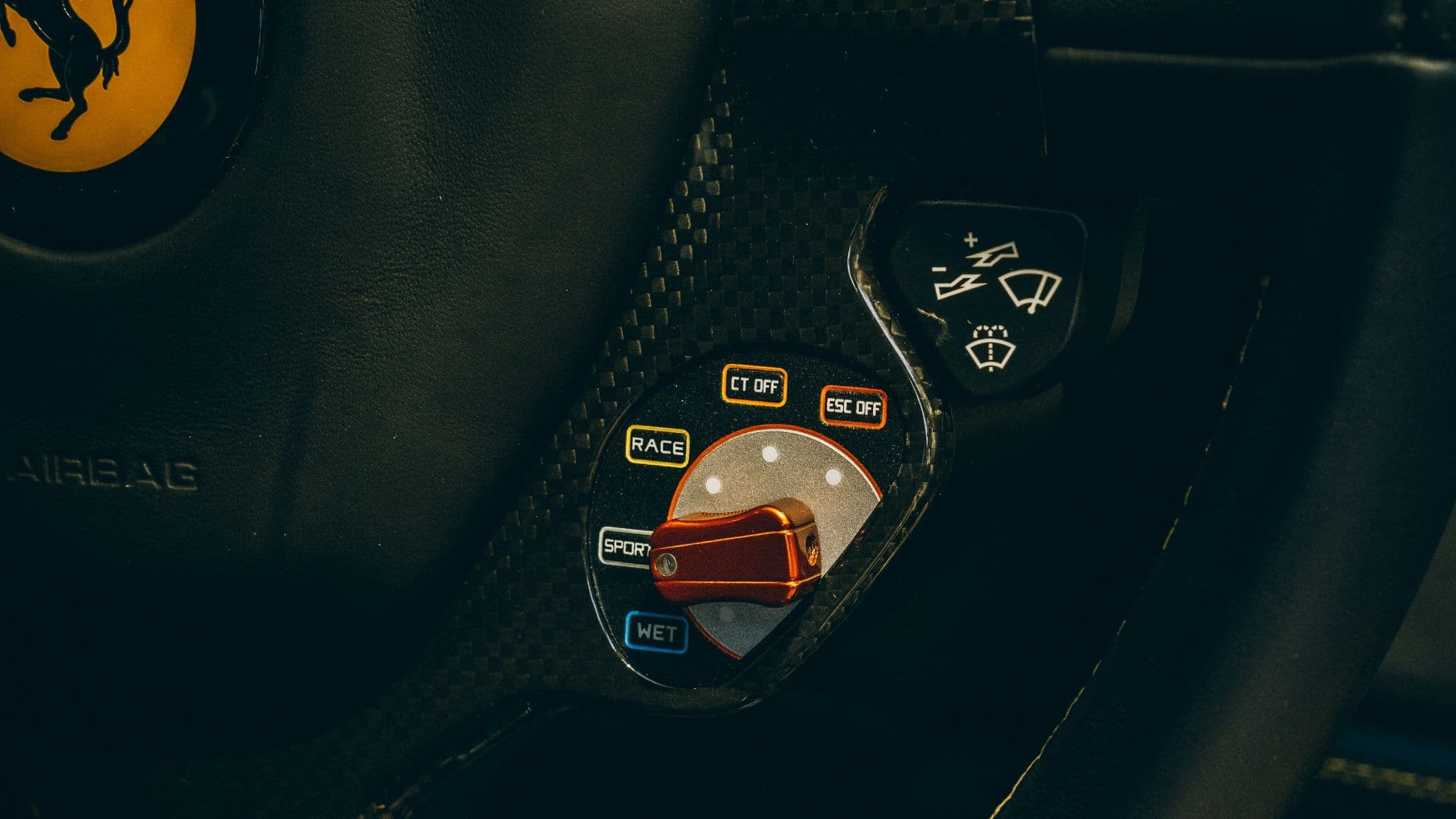
Ferrari Manettino Dial
Ferrari pioneered the art of tactile control with the manettino switch.
Turn from Wet → Sport → Race → CT Off → ESC Off, and you’re not just changing traction settings — you’re unlocking the car’s mechanical soul.
Each position adjusts:
- Throttle response curve
- Differential lock percentage
- Suspension damping rate
- Steering sensitivity
- Gearbox shift logic
In Race mode, for example, the F8 Tributo sharpens throttle mapping by 15%, increases rear-slip tolerance, and engages Side Slip Control 6.0, allowing controlled drifts while keeping the driver in command.
Lamborghini ANIMA System
In Lamborghini’s Huracán EVO and Aventador models, the ANIMA switch controls Strada (Street), Sport, and Corsa (Race).
Each transforms the entire car:
- Strada: smooth shifts, soft suspension, linear throttle — ideal for Dubai’s city cruising.
- Sport: sharper gear engagement, rear-bias torque, and a throatier exhaust tone.
- Corsa: maximum aggression, lightning shifts, and torque vectoring precision at its peak.
Drivers renting supercars in Dubai can tailor their experience to match the day — serenity or savagery, all in one switch.
3. Adaptive Suspension Systems: The Physics of Comfort and Control
Suspension used to be binary — soft or firm. Today, it’s intelligent.
Systems like Magnetorheological Dampers (MRD) in Ferraris or Proactive Chassis Control II in McLarens adapt in real-time.
How It Works
- The dampers contain fluid with metallic particles.
- When an electric current passes through, viscosity changes instantly.
- Sensors detect bumps or steering inputs and adjust firmness in 10 milliseconds.
That’s faster than human perception.
It means you glide over Sheikh Zayed Road one moment and carve corners in Hatta the next — same car, no manual adjustment required.
This ability to morph between comfort and precision is why modern luxury sports car rentals in Dubai deliver both serenity and thrill in a single drive.
4. Torque Vectoring and Stability Control: The Secret to Effortless Grip
Torque vectoring is the art of sending power where it’s needed most — not just between front and rear, but between left and right wheels.
Ferrari’s Side Slip Control (SSC)
This system uses data from gyroscopes and wheel-speed sensors to determine optimal torque distribution, allowing controlled oversteer without loss of traction.
McLaren’s Brake Steer System
Instead of mechanical differentials, McLaren brakes the inner rear wheel mid-corner, tightening your line — it’s digital agility engineered from F1 heritage.
Lamborghini LDVI (Lamborghini Dinamica Veicolo Integrata)
This neural network calculates data from 50 sensors, predicting what the driver intends to do before they do it — adjusting torque, steering, and damping proactively.
Dubai’s high-speed corners and smooth tarmac make these systems shine. It’s why a 700hp car feels controllable even at 250 km/h — precision disguised as ease.
5. Transmission Logic: Intelligence in Motion
Dual-clutch transmissions (DCT) are more than faster gearboxes — they’re predictive systems that anticipate your next move.
A Ferrari F8’s 7-speed DCT uses throttle position and brake input data to decide whether you’re preparing to accelerate or decelerate. It pre-selects the next gear before you shift, achieving gear changes in 60 milliseconds.
McLaren’s Inertia Push technique stores rotational energy between shifts, delivering continuous acceleration without lag.
This means the feeling of thrust never fades — a seamless wave of power sculpted by code.
The result? Emotion that feels mechanical, delivered by software.
6. The Role of Electronics in Safety and Confidence
While performance systems grab headlines, electronic safety architecture is equally sophisticated.
Every supercar now uses multi-layered redundancy — if one sensor fails, another compensates.
Advanced braking systems employ ABS Evo algorithms, which adapt braking force based on tire temperature and road grip.
For Dubai’s climate, where sand can shift traction unpredictably, these systems are essential. They don’t interfere; they empower. Confidence behind the wheel comes from knowing the car thinks as fast as you do.
7. AI-Assisted Dynamics: The Future Has Arrived
Artificial intelligence has officially entered the cockpit.
Ferrari’s Dynamic Enhancer, Lamborghini’s LDVI, and McLaren’s Optimal Control Theory all use machine learning models that study driving inputs — throttle aggression, steering smoothness, braking consistency — and adjust system behavior accordingly.
This is not “autonomy”; it’s augmentation.
The car refines its reactions to match your style, meaning two drivers can have two different experiences in the same car.
It’s the future of personalization — an exotic rental that adapts to you.
8. The Hidden Electronics Ecosystem: Behind the Dashboard
The modern supercar has more computing power than an early spacecraft.
Each vehicle uses 10–20 ECUs communicating through high-speed CAN and FlexRay networks.
Examples:
- Body Control ECU: manages lighting, doors, and climate.
- Powertrain ECU: coordinates engine, gearbox, and differential.
- Dynamics ECU: governs suspension, brakes, and steering.
- Infotainment ECU: integrates GPS, telemetry, and driver assist.
All of them synchronize through a central gateway.
When one system adjusts (say, torque vectoring), others adapt instantly (stability control, damping). It’s a ballet of electrons translating raw mechanics into seamless emotion.
9. User Interface Evolution: Human-Machine Synergy
The interface is where technology meets instinct.
Ferrari’s driver-focused cockpit eliminates distractions — all controls live on the steering wheel.
McLaren uses minimalist screens and rotary selectors to preserve purity.
Lamborghini’s fighter-jet layout turns every action into drama, emphasizing engagement.
In all cases, the goal is identical: connection.
Every dial, display, and paddle is designed to make performance feel natural, not complex.
10. The Dubai Factor: Optimized for Perfection
Technology doesn’t just enhance performance — it ensures reliability under Dubai’s unique demands.
At Superior Car Rental, our technicians ensure:
- All software is updated to latest manufacturer calibrations.
- Systems are recalibrated for desert heat and tire expansion.
- Traction systems are tuned for sand-prone conditions.
When you rent a sport car in Dubai, you’re not just getting horsepower — you’re accessing a digital ecosystem tested for local precision.
Conclusion: The Invisible Co-Pilot
Every beep, every shift, every subtle steering correction — it’s all part of a dialogue between human intuition and machine intelligence.
In the era of modern exotics, mastery means understanding the silent systems that make power usable, safe, and exhilarating.
Explore the fleet: https://superiorrental.ae/